
Your brand runs on people
What student theater taught me about scaling vision
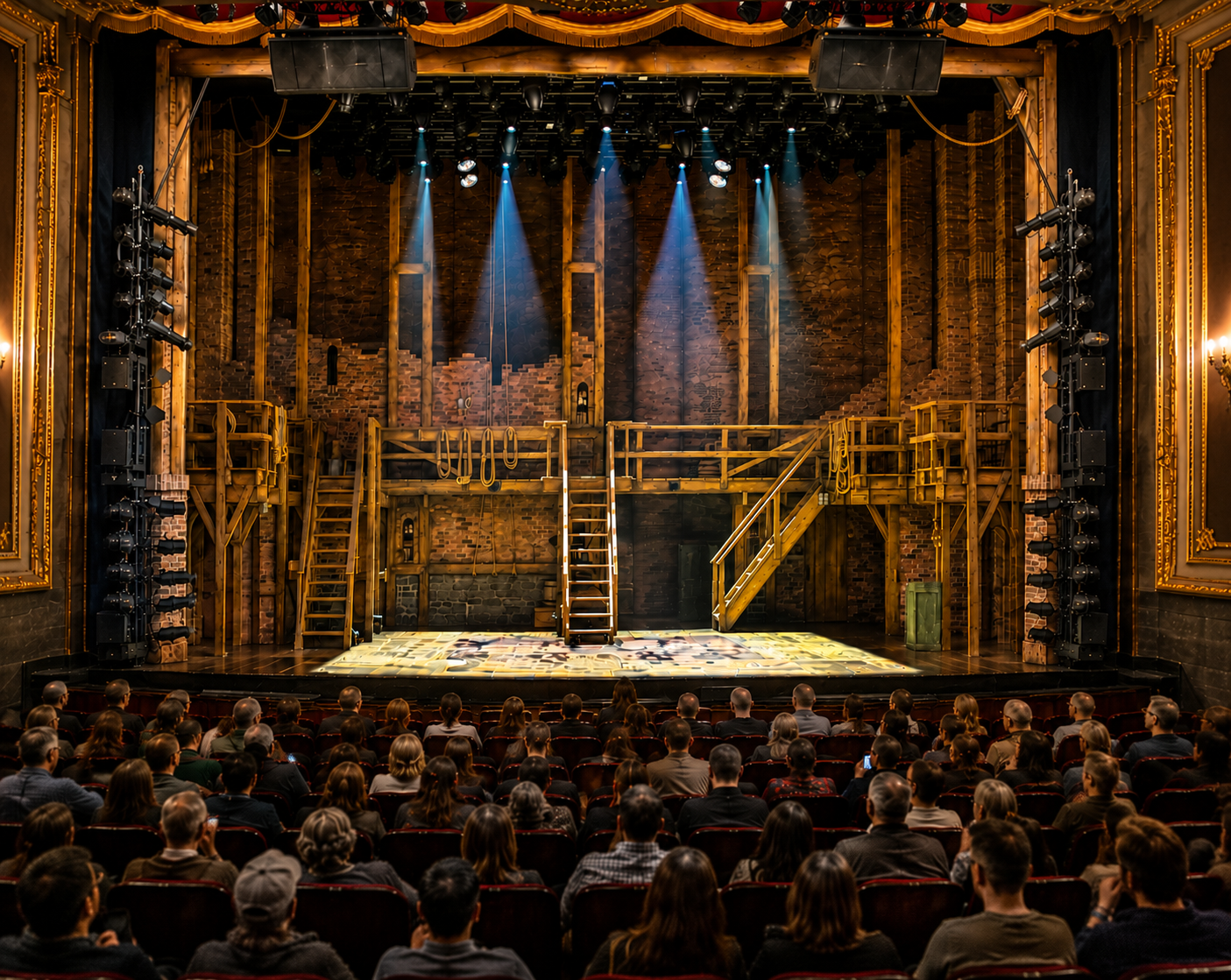
Photo: Hamilton, Citizens Bank Opera House, October 2025. A brilliant example of a vision, clearly owned by domain experts, carried through each craft.
I spent the majority of my college years working in student theater. I wasn’t a theater major, just a superfan of shows growing up, and loved getting a peek under the hood on how shows came to life. The creative process was always the same: starting with a director’s vision, sharp and specific in their head, brought to life by a team of talented experts across a dozen disciplines. What the audience got was the sum of hundreds of micro decisions: how lighting hit a street scene, where an actor chose to put a pause, a musical director’s call to let the orchestra drop out at a poignant moment. Cohesion came down to whether each discipline took ownership of the vision and carried it into their craft.
Brand building works the same way. As I’ve mentioned previously, brand reaches a customer through hundreds of decisions made by people across the business: a pricing call, a hiring standard, a vendor selection, a roadmap tradeoff. These are all decisions rightly owned by functional experts, but the sum has to feel intentional.
That means the people making those brand decisions can’t just be executing someone else’s mandate. They have to own the logic on their own - understand what you promised customers, see how their specific call either delivers or undermines it, and be able to defend the choice in their own words when it matters. Once the ink is dry on the brand strategy, it becomes a leadership effort to bring it to operationalization.
Building Belief
In the theater, the design concept gets locked before the shops start building. A director who keeps reopening it teaches the team to wait and see which version sticks.
It's the same in companies; no one wants to build against a target that might move. Not customers, not partners, and least of all anyone asked to organize around a brand strategy that could be rewritten next year.
Ask any Clorox alum what a durable brand platform looks like and we’ll tell you about Hidden Valley Ranch. Built off an insight that ranch wasn’t just for salads but a way to get kids to eat their vegetables, which meant the flavor could stretch to its own category and into dips, seasonings, eventually a shelf of its own. Team after team held to the strategy, and that's what turned one customer truth into decades of extension. That conviction allowed us to build plans a year out, make commitments to partners, and get comfortable making investments on a longer horizon.
Hidden Valley had decades of teams holding the line behind it. Many leaders are asking people to believe in year one. So the certainty has to come from what leadership does repeatedly, before the track record exists.
Ongoing recommitment. First, conviction has to be expressed consistently, not just declared at the outset. One CEO I worked with sent a company-wide Slack message every Monday morning. He used it to reinforce the brand and customer north star, while also sharing what wasn't resolved, including difficult tradeoffs and parts of the strategy still being worked out in implementation. He was in the messy middle as well, and every week the organization watched him recommit to the strategy.
Visible action. There is no better way to teach than by example, through decisions made on brand grounds, in public, with the reasoning attached. Early in the "Back to Starbucks" turnaround, the company restored the self-serve condiment bars in all stores, removed during COVID and never brought back because reversing it took real money and operational effort. At face value it wasn’t an obvious brand call but an important one given the impact to customers (who liked to have control over their coffee customization) and partners (operational tradeoffs and benefits) to reinstate it. The idea to reinstate it wasn't new - teams had been making the case internally for a while. What changed is that the CEO greenlit it and visibly tied the action to the brand turnaround, rebuilding a part of the coffeehouse experience the company had let go in the name of simplification and cost.
Measured in the open. The metrics that are reviewed publicly each week should reflect what the organization believes is the priority. When launching new products at Amazon, we reviewed CSAT, NPS, and customer verbatims every week in the business review, and each commercial and technical leader reported on the inputs their team owned to move them. These were not just general health metrics but also the closest read we had on whether the product was delivering what we had promised customers. At scale, the pattern is the same: leaders own an input tied to brand drivers and answer for it in front of peers. Earlier on it may be as simple as a founding team reading customer reviews together every week.
Say it more than once, make brand decisions out loud, and measure it where people can see. Teams will build more confidence in the strategy to hold it through their own decisions.
Establishing Ownership
A lighting designer doesn’t just take in and pass along the director's notes. They have to work out what it costs inside their own discipline, sometimes discovering that they built their whole plan around something that no longer works. Then they have to stand in front of their crew and explain why a change is worth it, to the people who will spend the next three days rewriting cues and sourcing new instruments. “Because the director said so" doesn't cut it.
Functional leaders face a similar burden, whatever the discipline. This is where operationalizing brand becomes real and hard: cutting a merchandising approach that used to work, reprioritizing roadmaps, redirecting their team on something they have spent months on, while defending the call, in their own words. How CEOs and GMs partner with their department heads determines whether those leaders can carry the change to their teams:
Shape the strategy together. Bringing functional leaders into strategy development is only useful if it is more than a listening exercise. The point is to get the tradeoffs and constraints they will be accountable for out on the table, before the strategy hardens into something they had no hand in shaping. Skip that step and you get polite agreement in the room, and non-compliance six months later because they never worked through the implications for their function.
Unpack the unsaid blockers. Sometimes it's straightforward - a need to clarify priorities, or a resource or technical blocker requiring a negotiation over investment or timeline. But the harder stall, requiring more direct intervention is when someone understands the brand reasoning from the start but struggles to hold it. I once coached an e-commerce leader as he was wrestling with pulling back on promotional depth and frequency. He understood the brand need, but understanding a case and holding it while your own numbers dip are different things. What he needed was someone to read the early signals with him until the reasoning was his to defend.
Know who can lead the change. Team leadership through change is an entirely different competency than functional excellence in stability. It looks like holding ambiguity in front of a team without pretending to have the answer, making an imperfect call and adjusting rather than waiting for certainty, and coaching people through discomfort instead of shielding them from it. Most leaders have never been assessed on it, and it doesn't surface until the work is already stalling, leaving teams frustrated absent decisive leadership. This matters for brand specifically: the leaders who can hold ambiguity are the ones who can defend brand reasoning to their teams even when the short-term signals are messy. While a seasoned leader can run with it, newer department heads need closer support from the start.
Taken together, these are what let a functional leader carry the brand work as their own, and stand in front of their team without borrowing someone else's authority.
Designing For Tension
My favorite moments in theater were in tech week, when the design team took over. Lighting, sound, and the crew moving the set worked in real time as the scenes ran together; wardrobe and cast worked out how a character actually moved once the costume was on. The best directors had set the vision and the guardrails clearly enough that each discipline could work the problem themselves, and they treated the tension between them as part of the process, not a sign something had gone wrong.
Building brands through strong cross-functional teams works the same way. Product, operations, sales, and marketing are all translating the same vision into different disciplines, and those translations do not automatically agree with each other just because everyone sat through the same brand strategy share-out.
Disagreement is healthy and can often get you to better outcomes, but only when the conditions are in place to resolve it productively.
Shared goals. Collaboration is a non-starter when teams are pointed at different outcomes. An R&D leader I worked with described the tension between his team and the commercial side as a mandate problem, not a people problem. His team was asked to protect margin. Marketing was asked to move volume. Those two were never going to reconcile on their own, no matter how much the teams respected one another. The fix is not picking a side. It is aligning the goals so both teams are working toward the same objectives, which puts the tension on how to get there rather than whether to go.
Governance and decision rights. Then get specific about who decides what. The same R&D leader had drawn this line explicitly: changes a consumer would never notice, anything that doesn’t touch the label, the story, or the sensory profile, stayed inside the development team. The moment something became customer-facing, other functions were in the room. I recall the same discipline at Starbucks, where the gold standard for a product was clear but micro decisions about it through execution required multiple teams by design. Yes, there is some cost: a line drawn well slows some decisions down on purpose. But without the line drawn somewhere, you get constant escalation or unilateral calls.
Space to test disagreements instead of arguing them. Even with decision rights and shared goals, two functions will read the same calls differently. Nobody in a theater argues for long about whether a costume works. They just put it on the actor and run the scene. The equivalent is agreeing up front on what would actually settle the question, whether that is a customer conversation, a small test, or an honest look at what the data already says. It changes the disagreement from whose judgment wins to what nobody knows yet, which is a much easier room to be in.
Put those three together and the disagreements resolve instead of hardening. The brand customers see is the outcome of what those functions decide together, but the collaboration has to be deliberately designed with aligned goals, clear decision rights, and the room to debate and test hypotheses.
Opening Night
A director does not earn a cast's trust by announcing a vision once and walking away, and a company does not earn its people's commitment to a brand by declaring it in a launch deck. It is slower and less satisfying than that: recommitting to the strategy when it would be easier to bend it, motivating leaders who can carry it in their own words rather than agree on the surface, and designing the conditions that let teams disagree productively.
On opening night, the director cannot fix anything. The lights go down and she experiences the show with the audience - the sum of hundreds of judgment calls made through the life of the production.
The same is true of a company, and none of it is brand expertise. It is organizational leadership. And this is why the work stalls even in companies with sound brand strategies.
You can quickly gauge where your company actually is on this. Pay attention to how a manager explains a decision that a customer will eventually feel. If the reasoning traces back to what you promised customers, the brand is operating. If it comes back to "it's what someone senior wanted," it isn't.
And if you are the one making those calls from inside a function, while not named explicitly as such, you have always had oversight over brand decisions - in the vendor you picked, the feature you cut, the hires you make. The customer experiences the brand through your teams’ work.
The director watches from the house while every discipline carries the show. A brand works the same way. It is not what a company declares itself to be, but what its people decide, one call at a time.
